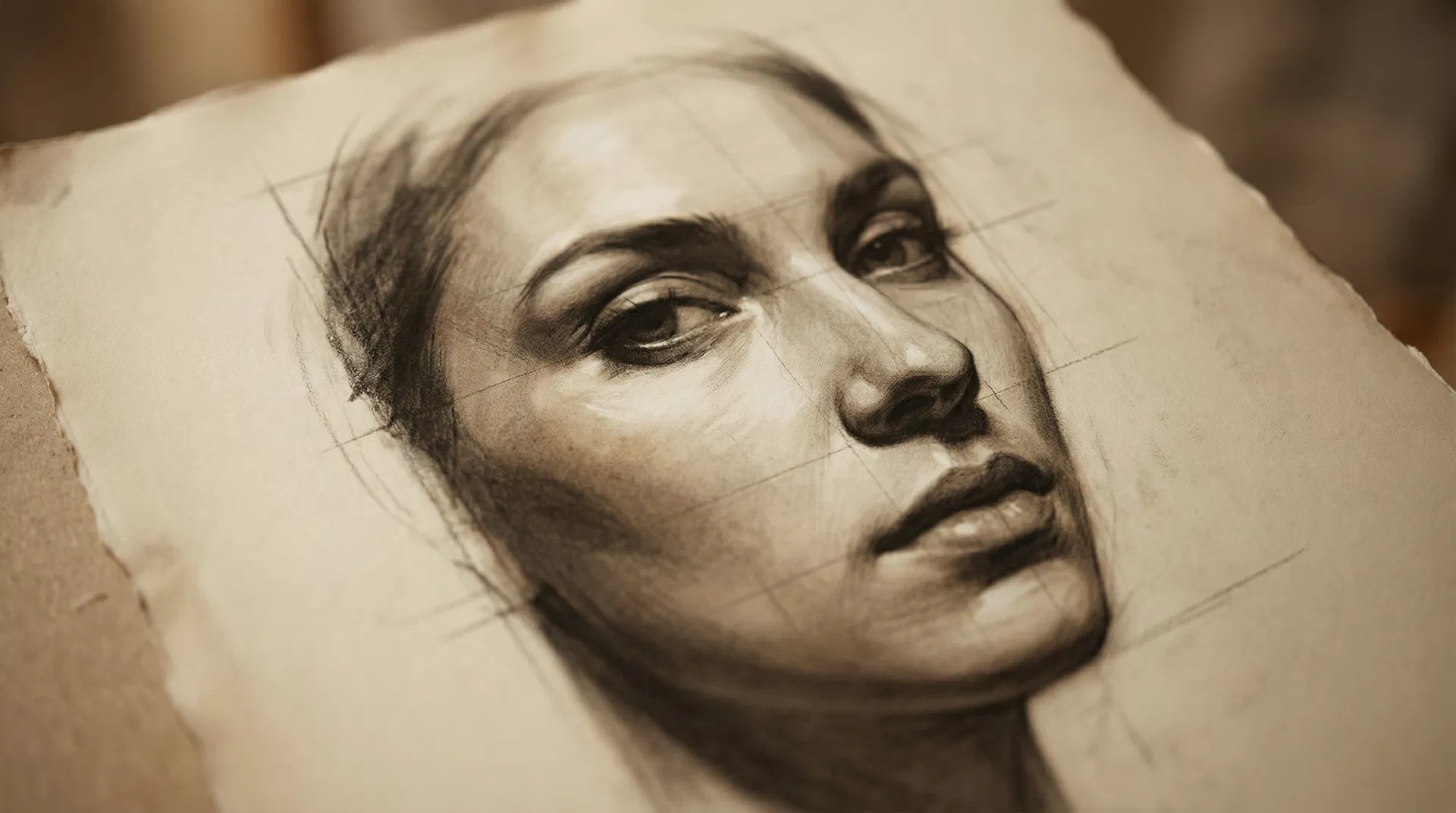
Drawing People
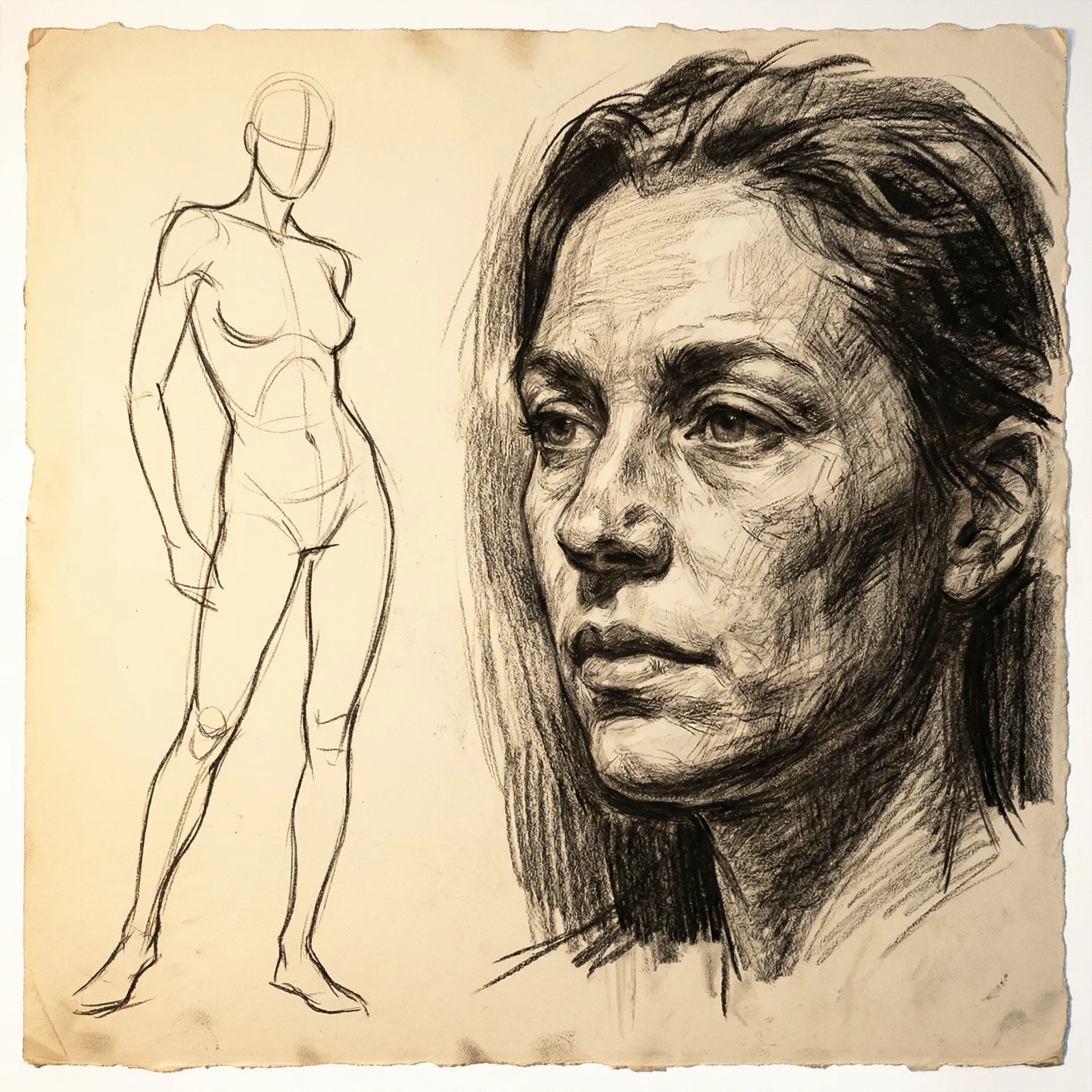
Now you’ll turn those observational skills toward the most challenging and rewarding subject there is. Four weeks learning to draw the human head and figure.
Overview
People are the hardest thing to draw
That’s also what makes them the most rewarding. This level takes everything you learned about measurement and observation in Level 1 and applies it to the human form — the specific proportions of the head, how features actually work in three dimensions, and the basics of figure drawing.
Everyone wants to draw people. But faces are unforgiving — get a proportion slightly wrong and it just looks ‘off.’ The good news is that the same measurement skills from Level 1 work here too. You’ll learn the specific systems for constructing heads and faces, and by the end you’ll understand why your portraits haven’t looked right before.
Duration
4 weeks
One session per week
Session Length
2.5 hours
Tuesdays 6:00–8:30 PM
Cohort Size
12 students
Maximum per group
Investment
£135–£165
Early bird / Regular
Weekly Curriculum
From skull to expression
Each week builds from structure to expression. You’ll start with the basic proportions of the head, move through individual features, learn how they work together to create likeness, and finish with simplified figure drawing.
Week 1
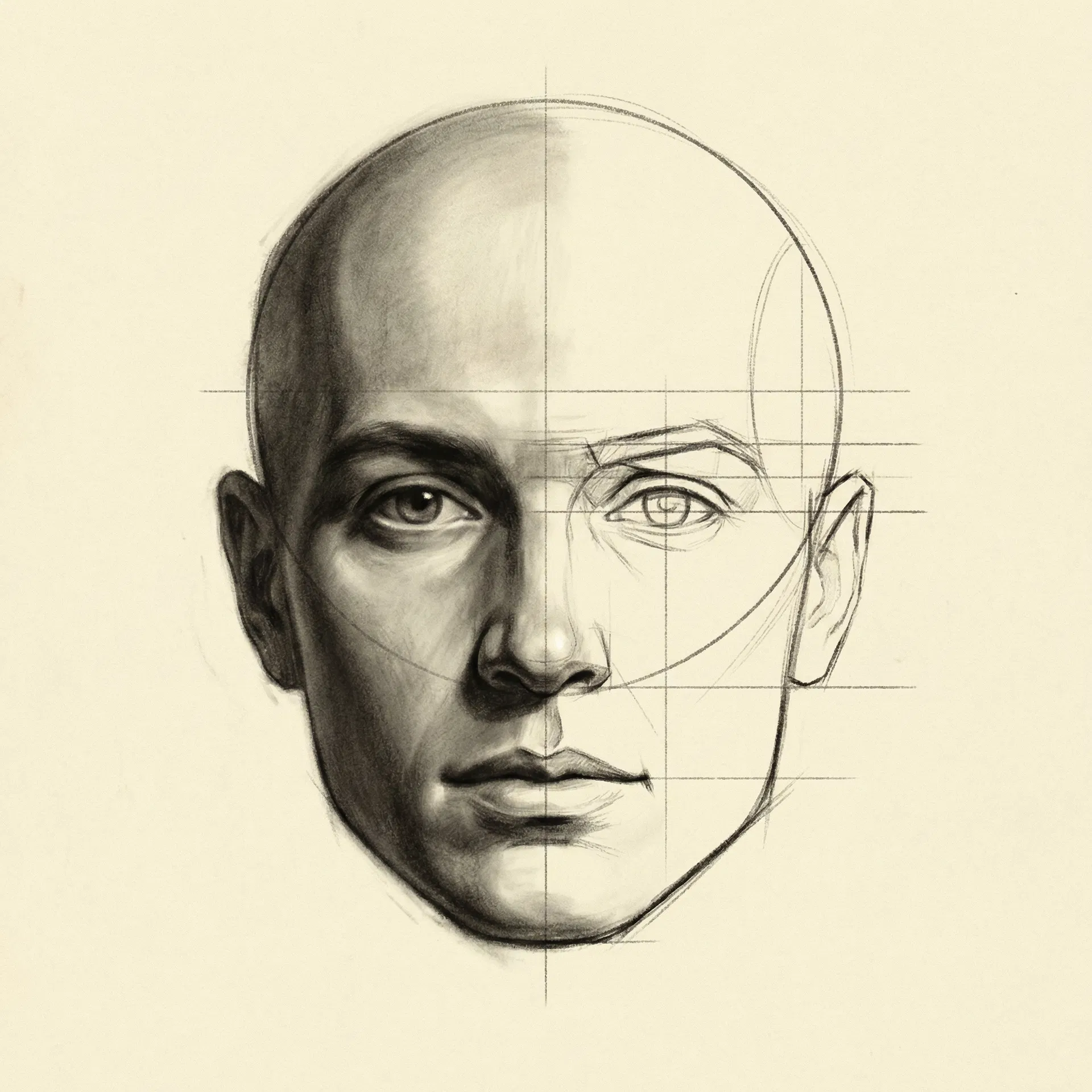
Head Proportions
The architecture of the human skull
You’ll learn the Loomis method for constructing the head — a simple system for getting the cranium, jaw, and feature placement right every time. It’s the foundation for everything else in this level.
Activities
Introduction to the Loomis method: circle for cranium, jaw construction, feature placement lines
Drawing the head from front view with proportional guidelines
Drawing the head from three-quarter and profile views
Understanding how proportions shift with head tilt and rotation
Week 2
Feature Structure
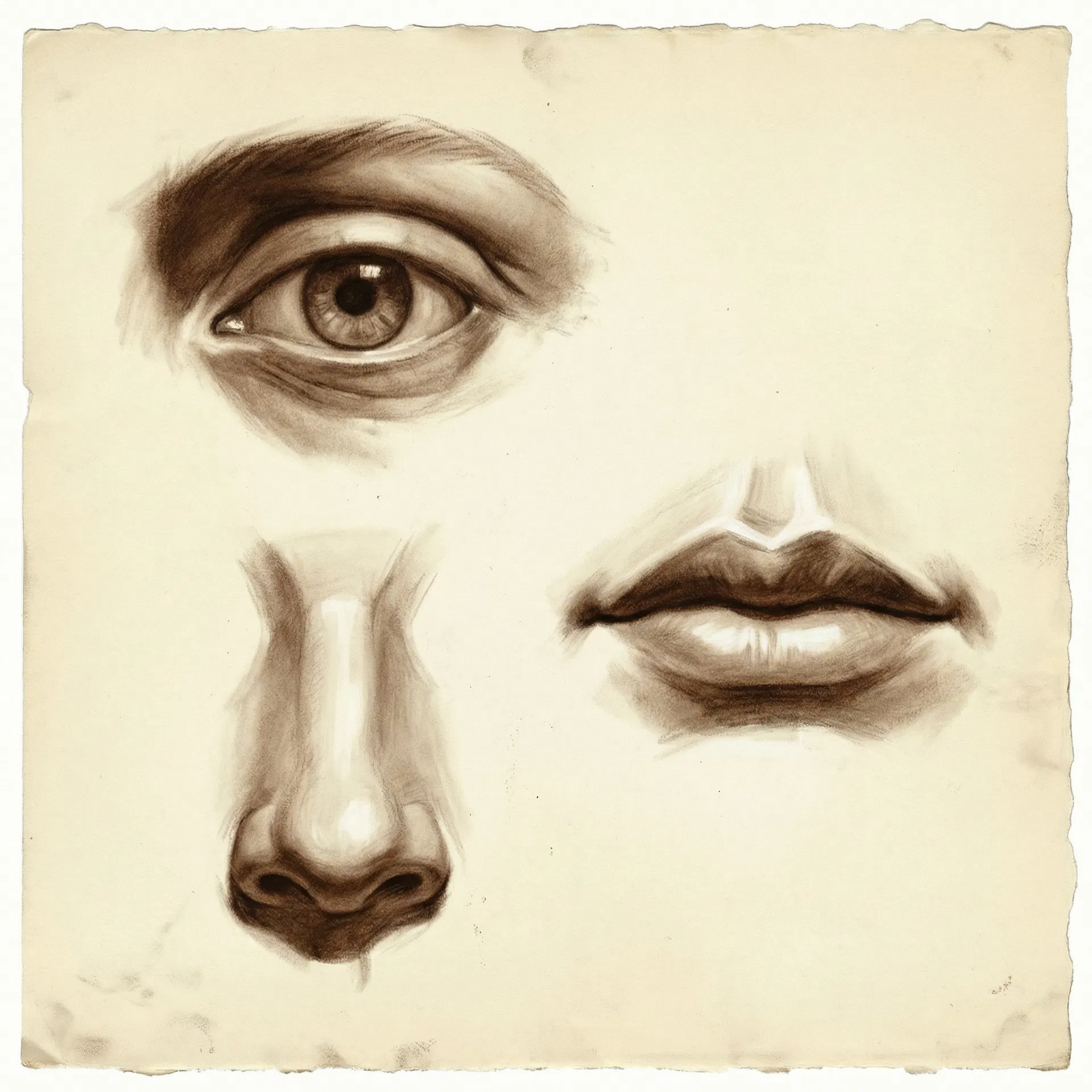
Eyes, nose, mouth — form before detail
You’ll learn to draw eyes, noses, mouths, and ears by understanding their actual three-dimensional form — not the symbols your brain has been substituting since childhood.
Activities
Studying the eye as a sphere within the orbital socket — understanding eyelid folds and iris placement
Drawing the nose as a collection of planes — bridge, ball, wings, and nostrils
Understanding lip structure — the characteristic light pattern on upper and lower lips
The ear as a complex form — simplified construction approach
Week 3
Facial Relationships
How features work together to create likeness
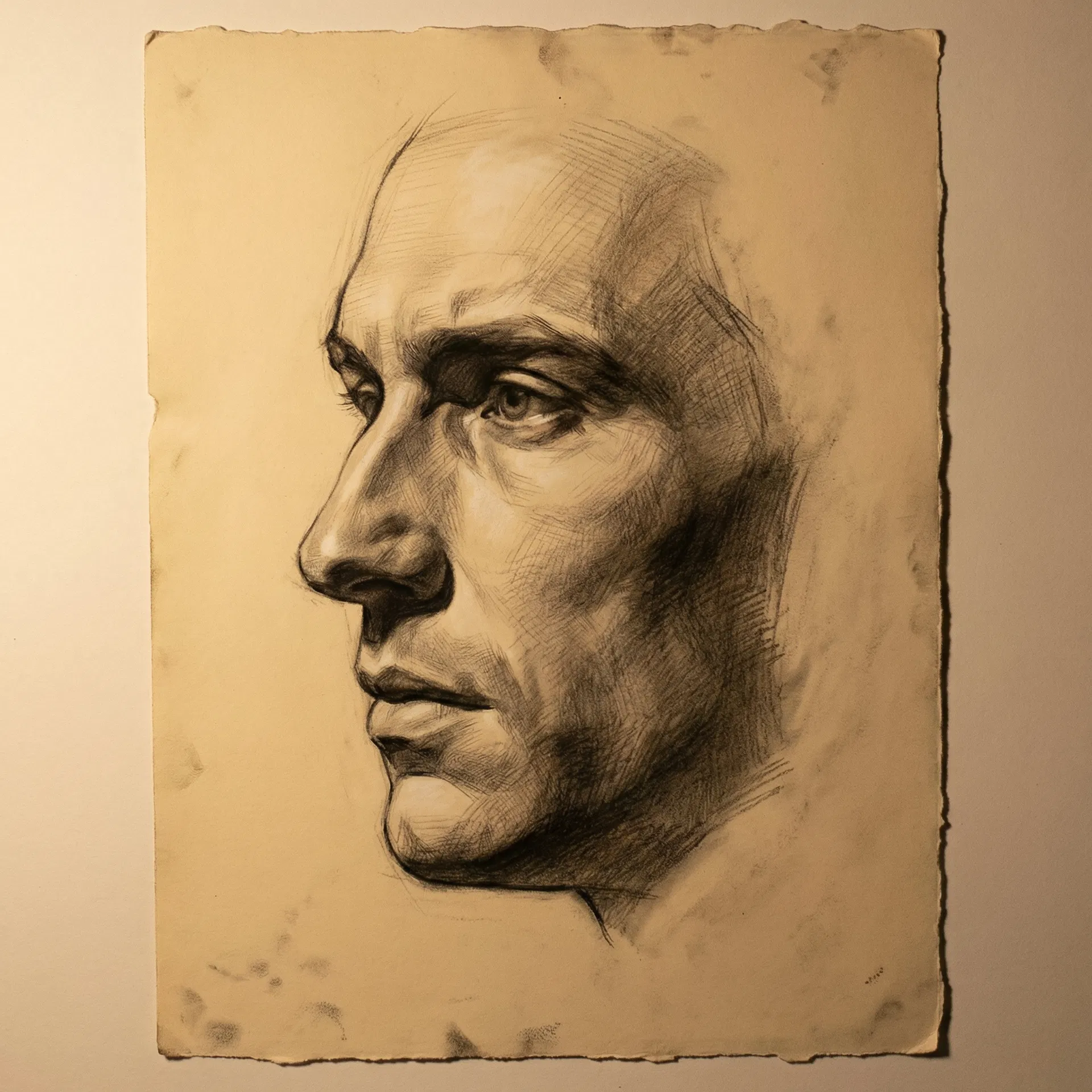
This is where portraits start to actually look like people. You’ll learn that likeness lives in the distances between features, not in the features themselves — and how light reveals the planes of the face.
Activities
Understanding the planes of the face — how the forehead, cheekbone, and jaw create light patterns
Measuring distances between features to capture individual likeness
Drawing complete portraits from reference with dramatic side lighting
Introduction to capturing expression through subtle feature adjustments
Week 4
Figure & Integration
The whole person, simplified
You’ll get an introduction to figure proportions and gesture drawing, then bring everything together in a complete head-and-shoulders portrait. We’ll also talk about presenting your work.
Activities
Introduction to figure proportions: the 7.5-head canon and simplified gesture
Quick gesture drawing exercises to capture movement and weight
Complete head-and-shoulders portrait integrating all learned skills
Group critique and presentation discussion for portrait work
Curriculum
What you will need
All materials are provided — you don't need to bring anything except yourself and a willingness to learn. Here's what you'll be working with throughout the course:
Drawing Surfaces
Cartridge paper (A3 or larger)
Toned paper (charcoal or grey)
Drawing Tools
Pencils (HB, 2B, 4B, 6B)
Charcoal (vine, compressed)
White charcoal or pastel pencil
Erasers & Blending
Kneaded eraser
Plastic eraser
Blending tools (tortillon, paper stump)
Reference & Other
Mirror for self-study
Portrait reference photographs
Pencil sharpener
Logistics
Course details
Who is this for?
Complete beginners start at Level 1. But if you already have some drawing experience, you can join at whichever level feels right for where you are now. Each level builds specific skills, so Level 2 assumes you understand proportion and observation, Level 3 assumes you can handle basic figure work, and so on. Not sure which level suits you? Just ask — I’m happy to help you figure out where to start.
Schedule
Tuesday evenings, 6:00–8:30 PM at Patch Bournemouth (the Academy room), 1st Floor at Bobby’s, The Square, 2-12 Commercial Rd, Bournemouth BH2 5LP. Ideally everyone starts together in Week 1 so we can build progressively, but I understand life can be unpredictable. If you need to miss a session or join a bit late, we can always arrange to catch you up.
Pricing
Each level is £165, or £135 if you book during the early bird window (opens two weeks before each level starts). You can take just one level, or all four — it’s up to you and what you want to develop.
Early Bird
£135
Regular
£165
Materials
All materials are provided. You don't need to bring anything except yourself and willingness to learn.
Between sessions
Each group has a private online space where you can post homework, ask questions, and keep the conversation going. I check in 2–3 times a week to give feedback.
Ready to get started? Spaces are limited to 12 per group, so they do fill up.
Enrol NowWhat You’ll Be Able To Do
By the end of this level
There are no grades or exams. But by the end of the four weeks, you should be able to do these things with growing confidence. I’ll give you individual feedback throughout, and we’ll talk about your progress in the final group critique.
Constructing Heads
You’ll be able to build a head from any angle using the Loomis method — front, three-quarter, and profile.
Drawing Features
You’ll be able to draw eyes, noses, and mouths as real three-dimensional forms, not flat symbols.
Capturing Likeness
You’ll understand why likeness comes from the spaces between features, and be able to measure those relationships.
Basic Figure Drawing
You’ll have a working understanding of figure proportions and be able to capture gesture and movement.
Bringing It Together
You’ll be able to combine everything into a complete portrait study with confident light and form.
The Full Programme
Four levels, four months
Each level picks up where the last one left off. You can take just one to work on something specific, or do all four for the complete foundation.