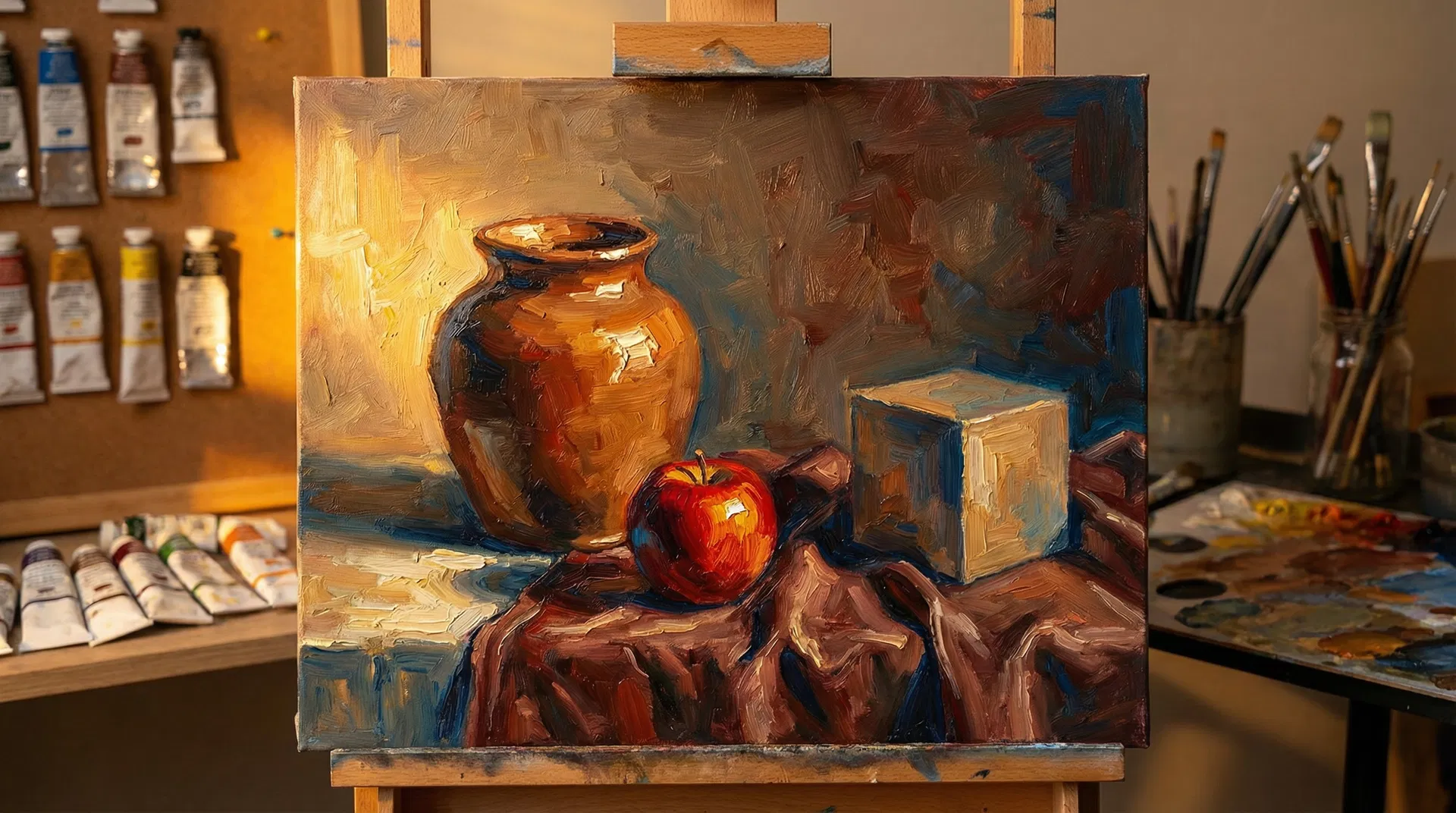
Colour Fundamentals
Everything you’ve learned about value still applies — colour just adds hue and temperature on top. Four weeks transitioning from charcoal to paint.
Overview
Colour is simpler than you think
Most people find colour overwhelming. But here’s the thing: every colour decision is really a value decision with hue and temperature added on top. Because you’ve spent three levels training your eye to see values, you’re already most of the way there.
This is where the charcoal gets put away and the paint comes out. You’ll learn to mix clean colour from a limited palette, understand why warm light creates cool shadows, and start developing your own colour sensibility. It’s the final piece of the foundation — and for many students, it’s the most exciting.
Duration
4 weeks
One session per week
Session Length
2.5 hours
Tuesdays 6:00–8:30 PM
Cohort Size
12 students
Maximum per group
Investment
£135–£165
Early bird / Regular
Weekly Curriculum
From charcoal to paint
Each week adds a new dimension to what you already know. You’ll start with mixing, move into temperature and value relationships, and finish by finding your own colour voice.
Week 1
Colour Mixing Principles
Understanding the language of pigment
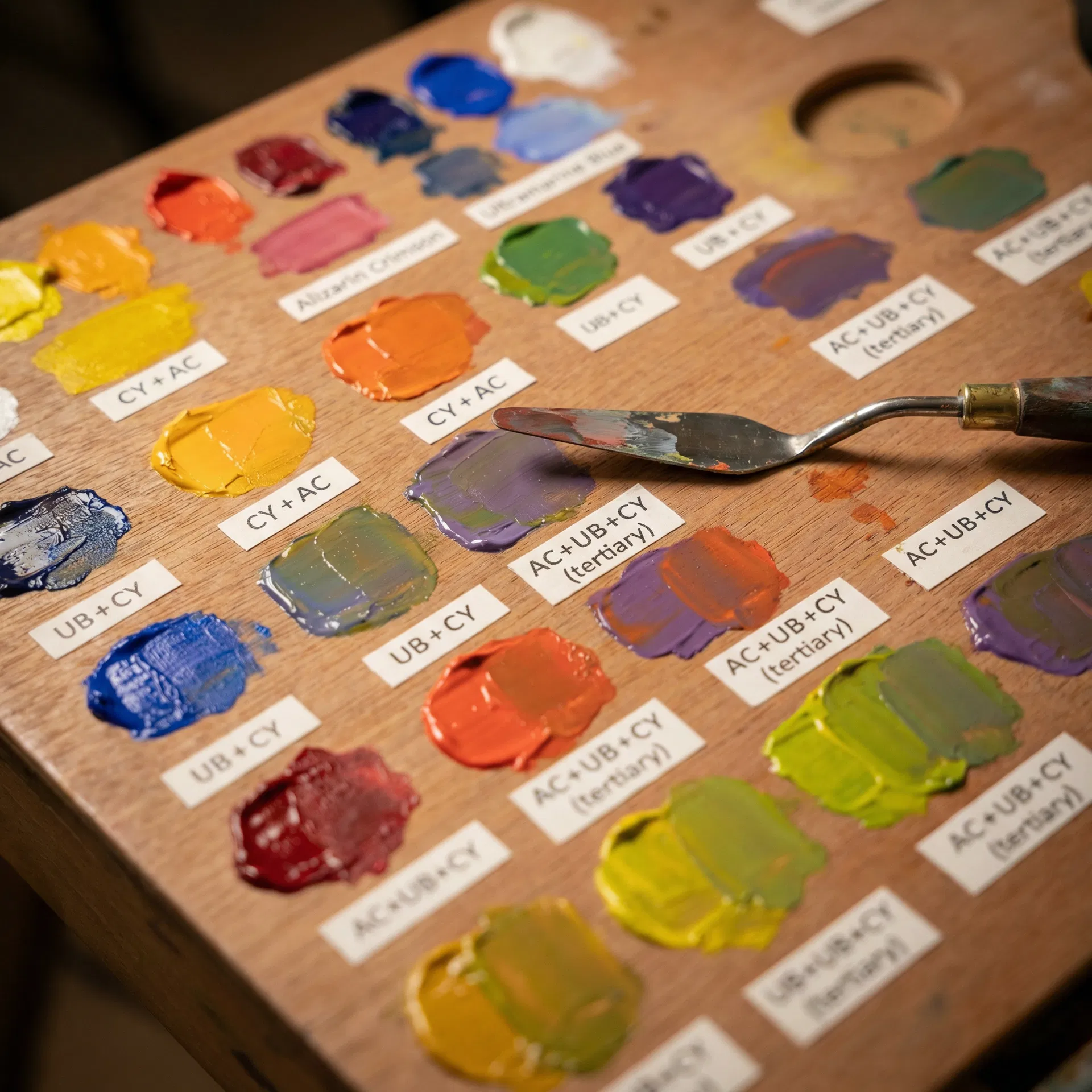
You’ll learn to mix clean, accurate colours from just four tubes of paint. It’s more limited than you’d expect — and that’s exactly the point. Constraints make better painters.
Activities
Introduction to the limited palette: cadmium yellow, alizarin crimson, ultramarine blue, and titanium white
Systematic colour mixing charts — documenting every two-colour and three-colour combination
Understanding colour bias — why some primaries mix cleaner secondaries than others
Mixing neutral greys and earth tones from primaries rather than using pre-mixed colours
Week 2
Temperature Relationships
Warm advances, cool recedes
You’ll learn to see temperature — the warm-cool spectrum that most beginners miss entirely. Once you see it, you can’t unsee it, and your paintings will immediately look more convincing.
Activities
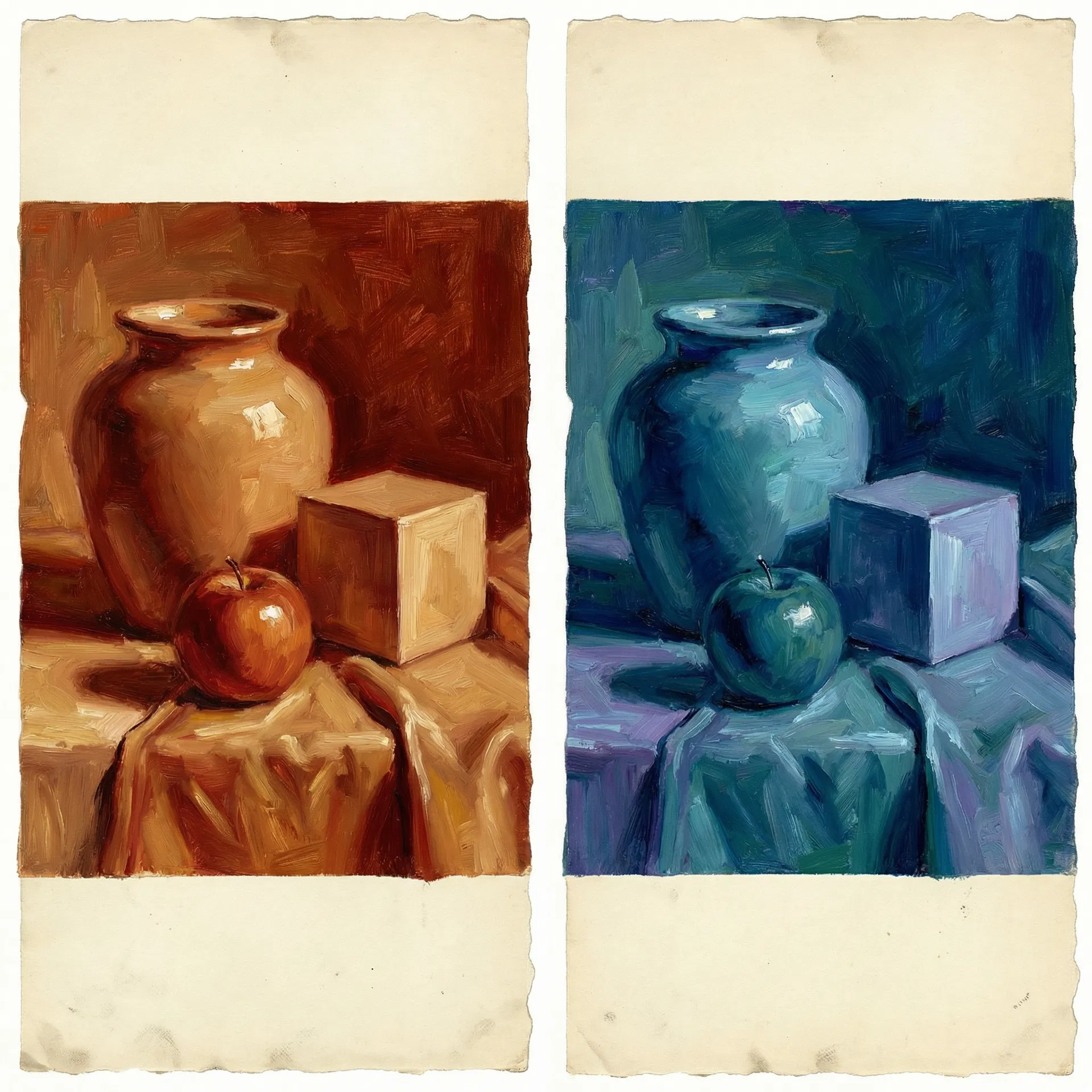
Painting the same still life twice: once in an entirely warm palette, once in an entirely cool palette
Understanding how warm light creates cool shadows and vice versa
Using temperature shifts to create spatial depth without changing value
Observing temperature relationships in natural and artificial light
Week 3
Value in Colour
The foundation beneath the hue
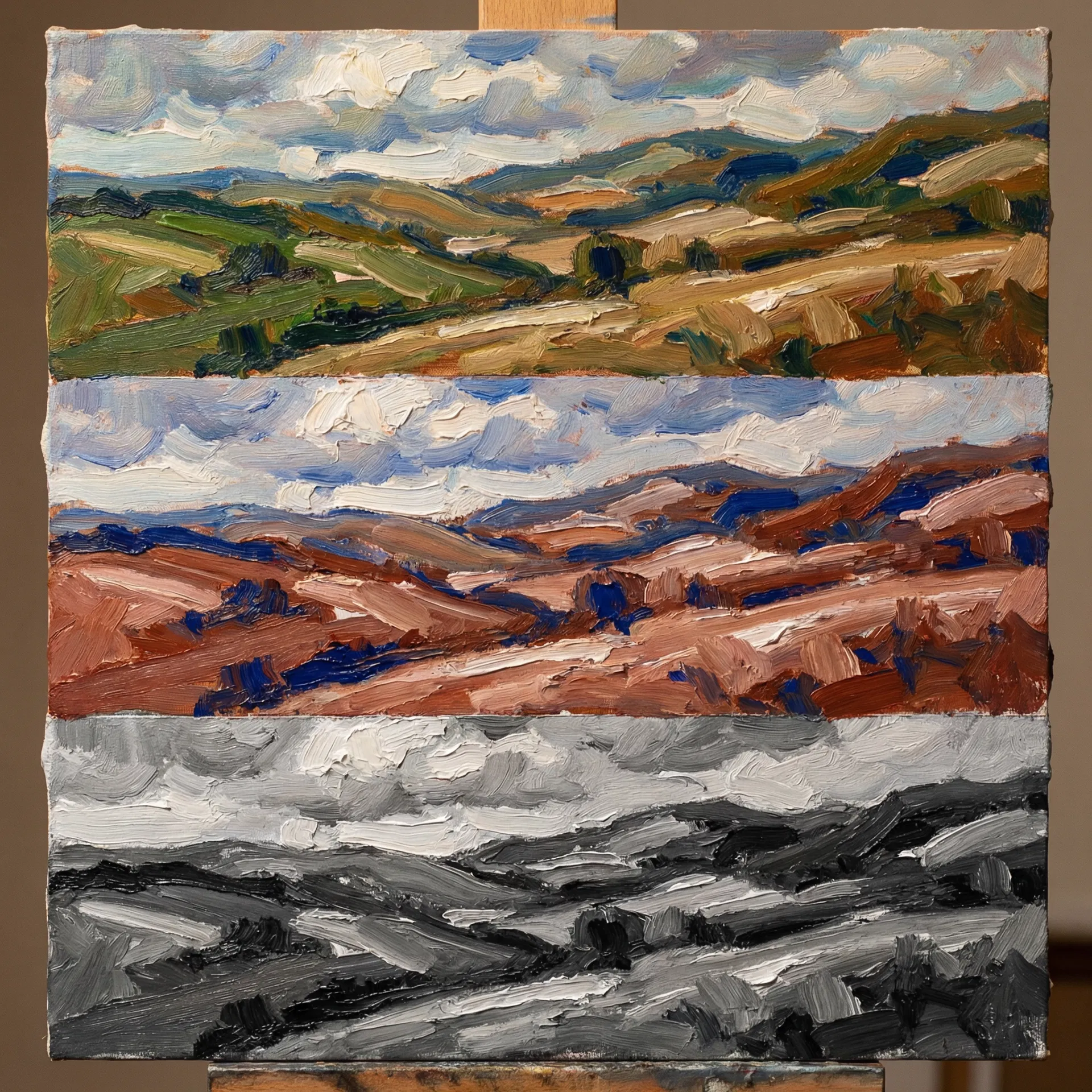
Here’s the secret: a painting with wrong colours but right values will always look better than one with right colours and wrong values. You’ll learn to see the value structure underneath the colour.
Activities
Painting a landscape in full colour, limited palette, and greyscale to demonstrate value structure
Squinting exercises applied to colour — seeing the value pattern beneath the hue
Correcting colour paintings by fixing value relationships first
Understanding why a painting can have wrong colours but right values and still work
Week 4
Personal Palette & Integration
Finding your colour voice
You’ll bring everything together in a finished painting using colours you’ve chosen yourself. This is where your personal taste starts to emerge — the combinations that feel right to you.
Activities
Exploring personal colour preferences — which combinations resonate with your artistic sensibility
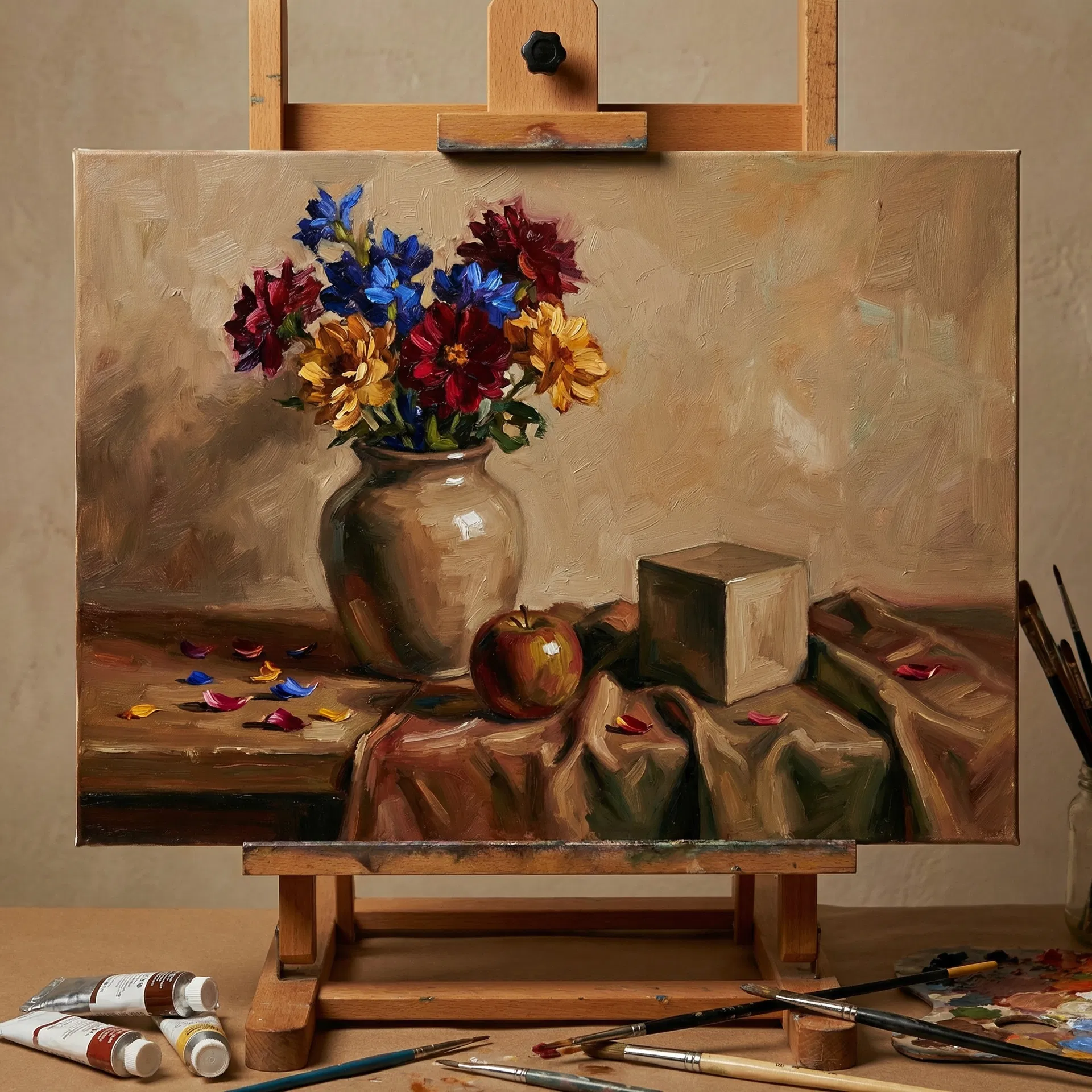
Creating a finished still life painting using a personally chosen palette
Integrating all colour skills: mixing, temperature, and value control
Final group critique and discussion of each student’s colour journey and artistic direction
Curriculum
What you will need
All materials are provided — you don't need to bring anything except yourself and a willingness to learn. Here's what you'll be working with throughout the course:
Painting Surfaces
Canvas boards (various sizes)
Primed paper or canvas pads
Paints
Cadmium yellow
Alizarin crimson
Ultramarine blue
Titanium white
Optional: burnt sienna, viridian
Tools
Palette (wooden or disposable)
Palette knife
Brushes (flat and round, various sizes)
Supplies
Solvent or water (depending on medium)
Rags or paper towels
Easel (tabletop or standing)
Logistics
Course details
Who is this for?
Complete beginners start at Level 1. But if you already have some drawing experience, you can join at whichever level feels right for where you are now. Each level builds specific skills, so Level 2 assumes you understand proportion and observation, Level 3 assumes you can handle basic figure work, and so on. Not sure which level suits you? Just ask — I’m happy to help you figure out where to start.
Schedule
Tuesday evenings, 6:00–8:30 PM at Patch Bournemouth (the Academy room), 1st Floor at Bobby’s, The Square, 2-12 Commercial Rd, Bournemouth BH2 5LP. Ideally everyone starts together in Week 1 so we can build progressively, but I understand life can be unpredictable. If you need to miss a session or join a bit late, we can always arrange to catch you up.
Pricing
Each level is £165, or £135 if you book during the early bird window (opens two weeks before each level starts). You can take just one level, or all four — it’s up to you and what you want to develop.
Early Bird
£135
Regular
£165
Materials
All materials are provided. You don't need to bring anything except yourself and willingness to learn.
Between sessions
Each group has a private online space where you can post homework, ask questions, and keep the conversation going. I check in 2–3 times a week to give feedback.
Ready to get started? Spaces are limited to 12 per group, so they do fill up.
Enrol NowWhat You’ll Be Able To Do
By the end of this level
There are no grades or exams. But by the end of the four weeks, you should be able to do these things with growing confidence. I’ll give you individual feedback throughout, and we’ll talk about your progress in the final group critique.
Clean Mixing
You’ll be able to mix any colour you need from a limited palette, without ending up with mud.
Seeing Temperature
You’ll be able to identify warm and cool areas in any scene, and use that to create convincing light.
Value in Colour
You’ll be able to check and maintain accurate values even when working in full colour — the foundation of good painting.
Your Own Palette
You’ll have started to discover which colour combinations resonate with you — the beginning of a personal style.
Complete Foundation
You’ll have all the fundamental skills to take your art in whatever direction you choose next.
The Full Programme
Four levels, four months
Each level picks up where the last one left off. You can take just one to work on something specific, or do all four for the complete foundation.